Nostalgia
CIS568: Game Design Practicum — Fall 2020
Unity, C#
Overview
I took a game design class under Professor Stephen Lane, and in this class, we learned about designing and developing 3D computer games. This course consisted of creating multiple games from scratch.
One of our projects in this class was to work in a team of three to develop a multiplayer game based off of a painting in Unity and C#. I worked with Catherine Liang and Anne Chen. We decided to base our game off of the painting A Wooded Path in Autumn by Hans Anderson Brendekilde. We liked the vibrant colors of the setting and how it lends itself to an environment that one could describe as nostalgic.

A Wooded Path in Autumn by Hans Anderson Brendekilde
Brainstorming
We decided to focus on the environment and the emotions that the game could evoke from players, and developed a story. Nostalgia is a narrative based game featuring two players. The user and their partner reunite after the longest time, only this time, one of them is a ghost. The ghost must guide their partner through puzzles to help them accept death and reach heaven as well. The user will travel through three distinct settings, learning more about who they were through finding clues together with their ghost partner. Although there is a main storyline, there are other clues players can find through solving puzzles to get a broader understanding of the character’s life.
We decided early on that we wanted to create different environments and puzzles in each environment for the two players to work through together.
Game Mechanics
The player connects to their partner using networking. Each player can explore their respective scene by using the keyboard WASD keys. One player is a human, who can interact with the physical world, and pick up objects. The other player is a ghost, who can control electricity, see things that humans cannot see, and reach places that are difficult to reach. Certain objects are only interactable for humans, and certain ones are only interactable for the ghost. Intractability is shown through outlines on the respective player’s screen. After the two players work together to solve a main puzzle, a portal appears to go to the next level, or setting. There are 3 levels.
An example of how the character-object interactions work is how there are certain objects that the human can interact with while the ghost cannot interact with. Here is an example of one of the scenes where the human can interact with a box in the train scene. The box outline occurs for the human character.


Red outline when nearing interactive objects
When in range, the human can interact with the object and switch camera view to zoom in on it. However, for the player who is the ghost, they do not see the outline and cannot interact with it.
No outline with objects player cannot interact with
UI Design
Catherine worked on the UI design, which we wanted to look rather vintage and give an “old-timey” feel to fit with the theme of nostalgia. We fashioned it to look like a train ticket, which is an object that players discover later in the game.

UI of Nostalgia game menu
Level Design
Anne made sketches detailing how we wanted each scene to look like. We based the first scene off of A Wooded Path in Autumn, which I modeled in Unity using Unity assets. The rest of the scenes were designed and modeled by Anne, and the sketches and final results are included here.


Park Scene: inspiration painting and final render


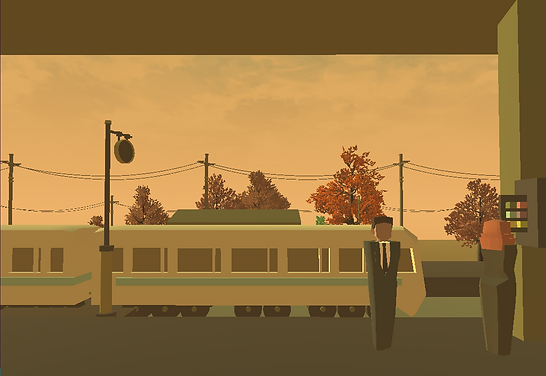
Train Scene: concept art and final render


Laundromat Scene: concept art and final render
Character Design
Catherine modeled the characters. The human is a woman, while the ghost is a man. They are dressed formally in old fashioned clothes.

The character models in the park scene
Story: Park Scene
We wanted to tell the story of two lovers, one of which helps the other into the afterlife by reliving their memories together. The human does not yet remember her past, but the ghost helps her remember by helping her solve the puzzles in each level, revealing more and more hints of their shared past.
The players start in the park scene at night. The ghost has the power to light up the lamps for a limited amount of time, and when the lamps are all lit, the human can see the coins that are under them. The human can then pick up the coins and put them in the news box to retrieve a newspaper with a note on it.
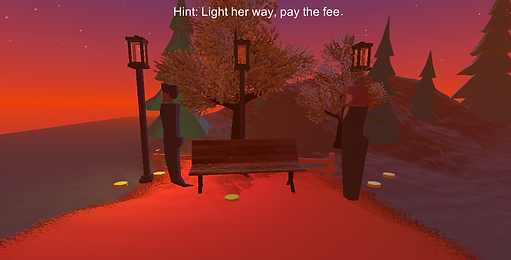

Left: ghost lighting up the scene for woman to pick up coins
Right: solving the puzzle to retrieve the newspaper with the note
Story: Train Station Scene
In the train station, the players are transported to an environment where there is a train speeding by in the background. The train is the same color for the human, but the ghost can see different colors for the train. There is also a lockbox which the human can interact with, and each keypad is a different color. The code for the lockbox corresponds to the color sequence of the trains which pass by, and the ghost player must convey this information to the human character to unlock the box with the correct code. Additionally, the ghost can float and interact with the sign above the train station, changing the message from showing the time to “do you remember me?”, a hint for the storyline.
When the human opens the lockbox, a ticket falls out, representing how the characters used to travel long distances to visit each other in the past, and this allows the characters progress to the final level.


Left: solving the puzzle to get the code
Right: receiving the train ticket

More story hints
Story: Laundromat Scene
In the laundromat level, the ghost can control the lights so that it shows a secret message which also inquires, “do you remember me?”
In this scene, the ghost can access the radio and play music which provides a hint as to what order the laundry machines need to be interacted with. When the human interacts with the laundromat, they can enter in a specific order to play music which corresponds to each machine. Together, they can figure out the order in which the laundry machines need to be selected to solve the puzzle.
Once the puzzle is solved, the ghost asks the human if she is feeling nostalgic yet, reminiscing on how their best moments together were mundane yet being with her made everything seem like an adventure. They take their last journey into the portal.


Revealing the message in the lights
Story: Final Park Scene
The players are transported to the park scene again, but this time it is near daylight. The human remembers everything now, realizing that the ghost came back to guide her. The ghost asks her if she’s finally ready to go, and the screen fades to white.


Final dialogue
Contributions
To break down the contributions from each member of our team, I modeled the environment for the park scene using free to use assets from the Unity store. I also used Photon Networking for Unity (PUN) to aid in the multiplayer game development and set up the ability to interact between instances of the game so different players can connect. Additionally, I implemented a dialogue system for the characters to speak after they have unlocked certain hints or cutscenes.
Anne modeled most assets such as the train scene assets and the laundromat scene assets. She also painted the brainstorming sketches for the environments and helped texture our backgrounds.
Catherine modeled the two main characters and implemented the UI design and created the general aesthetic for the UI. She also implemented the animations, such as the train animation, the box opening animation, and the ticket falling animation.
All of us together worked on the logic for the puzzles in each level, and helped with the character movement implementation. We all contributed to the storyline development as well.
Final Results
Here is a demo video of the final product of Nostalgia.